Short, live sessions over several weeks. Each one turns the same loop — and the loop is what makes it stick.
Immersive learning for teams that need capability, not just a certificate.
Training your team actually uses — long after it ends.
Most teams come to us because the last course didn’t stick. People came back energised, drowned in the backlog that piled up while they were out, and within weeks almost none of it was in use. Immersive training is built to end differently.
What changes for your team
They apply it the same week. Every concept lands in your real backlog while it’s still fresh — not ‘someday’.
Skills compound. Each session builds on the last, so capability grows instead of fading after a two-day blur.
They keep improving without us. You leave with a team that adapts on its own, not one waiting for the next course.
How immersive learning works
One loop, repeated until it’s a habit
Learn a concept, practise it in the room, apply it as a real assignment in your actual work, then reflect together — and that reflection opens the next session. Every turn compounds the last.
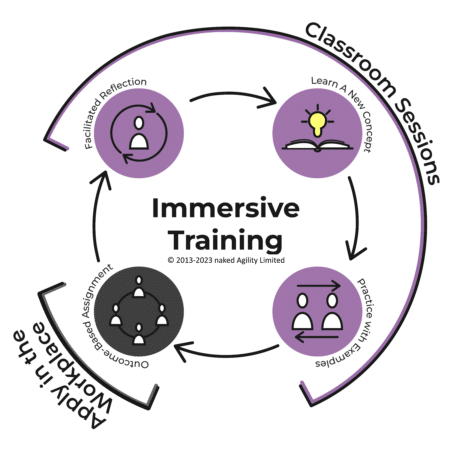
What each step looks like
Learn a concept
A short, live session — kept tight so attention holds — introduces one idea at a time.
Practise it in the room
You work it through with peers and your trainer before it goes anywhere near production.
Apply it at work
An outcome-based assignment puts the concept straight into your real backlog, with your real team.
Reflect, then go again
The next session opens with what happened — what worked, what didn’t — and the loop turns again.
Why it sticks: three loops, not one
A two-day course can teach a team to run a practice correctly. What it can’t do is change how the team learns — and that’s the part that lasts.
Durable capability is built across three loops of learning. A classroom event, at best, touches the first. Immersive training — practice in real work, reflected on, week after week — is the only format that reaches all three.
Researchers call this triple-loop learning. We call it a team that doesn’t need us anymore.
Are we doing it right? The team executes the practice correctly.
Are we doing the right things? The team questions the assumptions underneath how it works.
Are we getting better at getting better? The team builds its own capacity to adapt — and keeps improving after we’ve gone.
“After a full day of training and a time zone shift, they were still engaged, still asking questions, still figuring out how to make this stick. That tells me we’ve got something special happening here.”
— CEO, UK insurance software company
What it looked like in practice
A UK product team and its engineers in Poland were misaligned on roles, strategy, and delivery. Instead of standard product owner training, we ran an eight-week immersive mentorship inside their real work.
Product owners moved from passive coordinators to active shapers of value.
UK and Poland aligned on language, goals, and rhythm — and started working as one team.
Teams began solving previously intractable problems on their own, instead of escalating every one upward.
See how an eight-week immersive mentorship changed a cross-border product team.
Read the case studyIf immersive can’t fit your calendar
Immersive is how we prefer to work, because it’s the only format built to reach all three loops. When schedules genuinely can’t flex, we also run these — offered honestly, weakest last.
Staggered days
Sessions spread across a few weeks. A partial version of the loop — some application and reflection survive between sessions.
Full or half days
A condensed classroom format for when time and budget are fixed. The honest trade-off: people are out for the day and return to a backlog that built up while they were gone, so the least of it stays in use. We’ll tell you when this is the wrong call.
Tell us where your team is and what needs to change. We’ll design the right immersive programme — or the closest fit your calendar allows.
Start a conversation